
Let's consider two different disputes:
Situation 1: Mr Smith and Mr Durand
Mr Smith has been working with Mr Durand for five years. Mr Durand supplies Mr Smith with French delicacies. The latter sells them in the UK. His clients really are fond of the French cheeses and wines he has on display. His gourmet shop is doing fine, and he is satisfied despite late deliveries from France. Mr Smith knows however that a handful of loyal customers are vital to his small business. Mrs White, for example, regularly buys Cantal entre-deux, as well as a bottle of nice Armagnac from time to time. Over the past months, deliveries of Cantal entre-deux have arrived late. Each time Mrs White entered the shop, she could not find her favourite cheese and left the shop without anything. Mr Smith has not seen Mrs White for a while. He has difficulties selling the Cantal entre-deux that she enjoys. It is time to renew the contract that he has signed with Mr. Durand. He would like to add in the updated version of the contract a clause specifying that Mr. Durand should take unsold items back at his own cost. He also thinks that Mr Durand should pay penalties for late delivery. Times are difficult; Mr Smith cannot afford to be as lenient as he has been so far. From the other side of the Channel, Mr Durand sees the situation quite differently. He has noticed that times were difficult since Mr Smith has paid him late quite a few times. As a result, he has not been able to order Cantal entre-deux on time. This is a fine cheese. According to Mr Durand, Mr Smith should make a bigger effort to promote it.
Situation 2: Rose and Sue
Rose and Sue are neighbours. Sue loves partying. Rose enjoys spending time quietly in her garden. When she invites people for a garden party, she uses a barbecue. As a result, Rose can smell the barbecue. She really is unhappy about it. Sue is quite litigious and complains about Rose's plants because she feels invaded by them.
If they browse the Internet to find a solution to their dispute, they will find more or less straightforward answers to their questions. They will then seek professional assistance from a lawyer to double check and apply the solution that they have found on the Internet. They may be surprised when they discover that the practitioner turns a simple matter into a highly technical issue. They may also be disappointed because the lawyer does not seem to care about the practical solution at all. The client indeed wonders what the lawyer does with the law (1), and how he can interact with the practitioner to find a solution that is cost-effective, faster, and more convenient than an abstract court decision that has involved hours of legal proceedings (2).
1. The lawyer and the law
Let's see how a lawyer thinks.
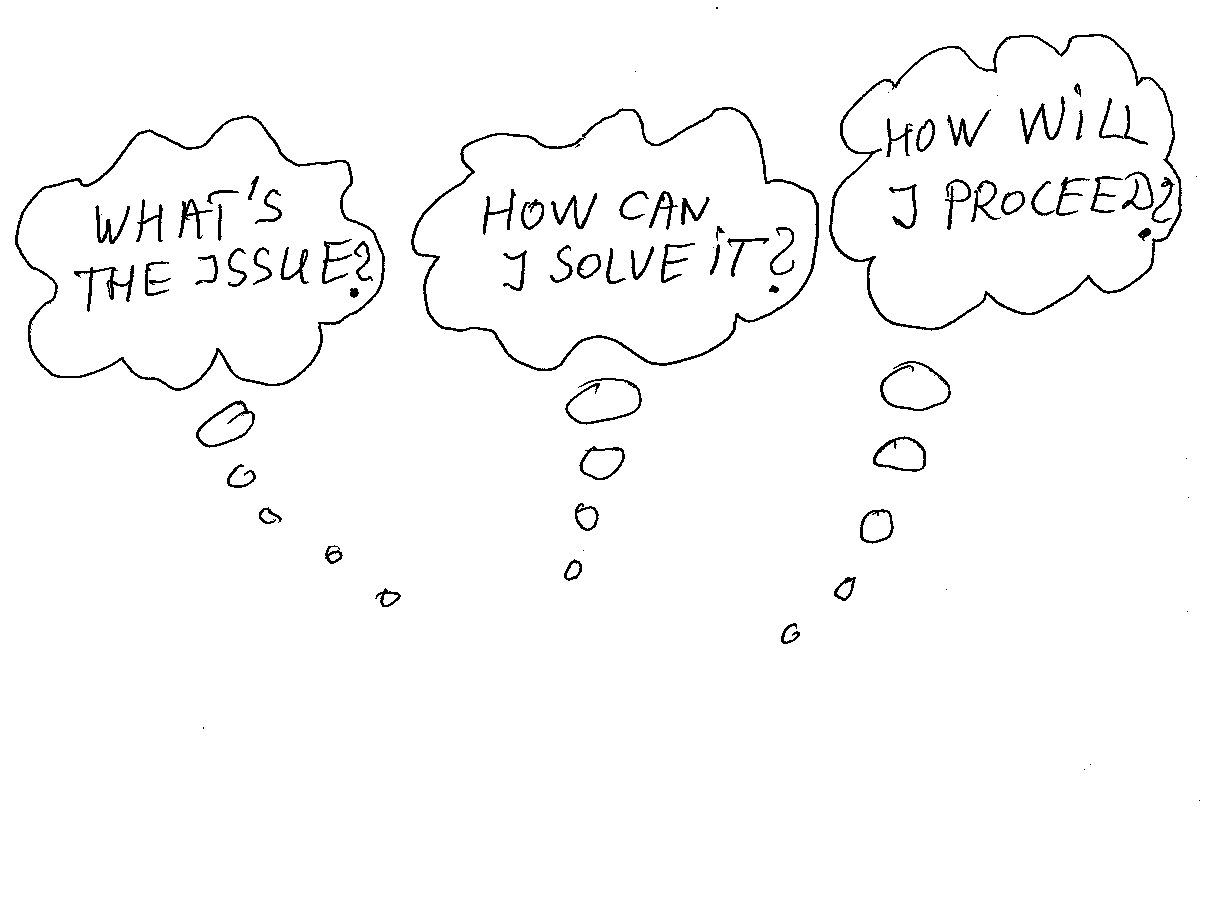
Lawyers often emphasise the second step of the process. Clients also are in search of legal solutions and therefore pay less attention to the first and last steps. Nevertheless, examining them allows the client to understand why he has the impression that lawyers live on a distant planet. Legal difficulties (1.1) will be considered before legal practice (1.2).
1.1 Legal difficulties
Education changes the perception of a given situation. A legal background enables the lawyer to notice important things that would seem insignificant to the layman. Why are they important? The legislator has enacted different pieces of legislation applicable to different situations. It can be tricky to determine what legislation applies and what can be changed to trigger the application of a different legal status that has a better effect in practice. To determine how to act, the lawyer looks at the facts of a given situation and sees how they fit in the legal framework. He therefore has to select the relevant facts. Facts that seem less important may be dropped out of the picture. It may seem obvious but when the client enters the practice, he tends to forget to tell what matters to him since he concentrates on what the lawyer says. The client may feel frustrated since he may have the impression that the lawyer does not care about him. The practitioner however has to leave anything that does not seem to cast an interesting light on the matter aside. Facts and circumstances that seem crucial to the client will not be taken into account if a lawyer who does not know the client cannot perceive the effect that these facts or circumstances have on the cause. It thus is very important for a client to tell his lawyer how he feels and what matters to him. If Mr Smith does not tell his lawyer that he has bought the shop from his uncle who was a good friend of Mr Durand and that it was their idea to establish this gourmet shop, he certainly will not notice that the delays are not the major cause of conflict.
Similarly, if Rose does not tell her lawyer that she feels deprived of any kind of privacy each time Sue enters her garden, the lawyer probably will not be able to understand that the barbecue is only one aspect of the problem. Furthermore, he will not be able to find out that if Rose let her plants grow without control, it is not because she hates her neighbour but because plants are a natural fence, and also because her joints hurt, and she cannot afford to have to garden maintained by someone else. These two elements that do seem "legal" to the client may change the conflict and may allow to find a faster and therefore cheaper solution. Rose has to know that for a lawyer everything is legal since law covers every aspect of life.
Law indeed is a tool that helps people who find themselves in a situation that may have or will have negative consequences. It empowers them by allowing to make decisions that really will have an impact on their future. Nevertheless, people often feel overcome by powerlessness when they consider their legal difficulties. This impression comes manly from legal practice.
1.2 Legal practice
Justice looks at the past. To find a reliable solution one has to look forward, and cannot constantly think about the past. The problem is that a court only looks at the past. In fact, it cannot look forward. It only can decide what should have been done but obviously cannot decide what a party who can express his will should do next. Court decisions may arrange things for the future, e.g., decisions regarding child maintenance. However, the judge only intervenes when parties have not been able to find an agreement by themselves.
Justice is a balance. A court has to find the right balance between claims. If one party prevails, the other loses. A party may thus be tempted to put weight on the opposite plate. Sue's barbecue has caused inconvenience, but Rose's plants have invaded Sue's garden and have destroyed her grass. Mr Durand has delivered the cheesed ordered late, but Mr Smith has not paid him on time and sometimes has not paid him at all. This stressful process does not allow to find a reliable solution since, as seen above, significant and practical difficulties might not have been identified. Furthermore, clients often have a solution in mind that they hope to force through court proceedings but do not consider the fact that when they finally get to end of litigation the solution that had in mind may not be convenient since time has past and the situation has changed.
Knowing all this, a client can decide to cooperate in a different manner.
2. The lawyer and his client
Let's now see how a client can avoid legal complications (2.1) and find a practical solution (2.2) with the assistance of his lawyer.
2.1 Avoiding legal complications
Do not fuel the conflict! Clients often seek the assistance of a lawyer to put an end to a conflict. They invest a lot of energy, time, and money in their case since it may be the most serious dispute they have ever had in life. They also want to make the most of their lawyer's assistance. They therefore send him many e-mails revealing embarrassing information about the other part and provide the lawyer with counter-arguments. Their lawyer will pay attention to them but the more information he provides the court with, the less clearer the case will be. Less is more. It is important to state clearly what matters and to provide the lawyer with any information that may seem relevant. It however is unnecessary to try to make the other party look worse. The client should not compare himself with the opposite party. He should be focused on the solution rather than on the dispute. When a client expects blood and tears, he finds himself with law and fees.
Stop calculating, start creating! Litigation often relies on rules that may seem complicated. The client therefore may feel overcome by the dispute. He may also try to predict how the other party will react. Nevertheless, the context of the dispute will change and these calculations will be worthless. It is suitable to determine with the other party what a good solution may be since a lawyer can help to turn it into reality.
The major steps of this settlement process are described below.
2.2 Finding practical solutions
It has been seen that court proceedings do not lead to practical solutions. Moreover, it really is hard to find a reasonable and practical solution to a conflict since it requires to build something with the opponent when anyone would rather let everything go because of fear or anger. A lawyer supports the client progressing toward a practical solution while making his best to reach an agreement that is as solid as a court decision. Law has evolved, and parties are now strongly encouraged to settle instead of going to court1. When it comes to the enforcement of non-judicial decisions on an international scale, French judges are inclined to enforce awards that have been issued by arbitrators, even when matters decided have nothing to do with French law. The same happens with settlements that have been reached following a well-know alternative dispute resolution process. In France, collaborative law is recognised as the "most accomplished form"2 of alternative dispute resolution. Collaborative law is a process that involves the parties and their lawyers. It is divided into four basic steps:
- parties express their feelings;
- parties determine what they need;
- parties and lawyers consider all the available options;
- parties and lawyers settle the dispute.
The parties and the lawyers can express themselves freely during sessions since the whole process is confidential. Parties can sign a binding agreement but are not obliged to and can withdraw from the process at any stage. If a party does so, the process ends and lawyers cannot file court proceedings; they all have to withdraw as well. Nevertheless, any party can still sue the other with the assistance of a different lawyer.
In brief, litigation is past-focused, and time-consuming whereas collaborative law is focused on the future and therefore allows to consider realistic options much sooner. Moreover, in contrast to court litigation, a party can reconsider the situation or even decide to go to court at any stage of the process. Collaborative law empowers parties to decide what they think is best for them and to turn the final agreement into reality.
-
See for example, Halsey v Milton Keynes General NHS Trust [2004] EWCA Civ 576 (11 May 2004) in English law; article 56, first paragraph, 4º of the French civil procedure code. ↩
-
P. Delmas-Goyon, Report to the French minister of justice, Le juge du XXIe siècle. Un citoyen acteur, une équipe de justice (2013), p. 63. ↩